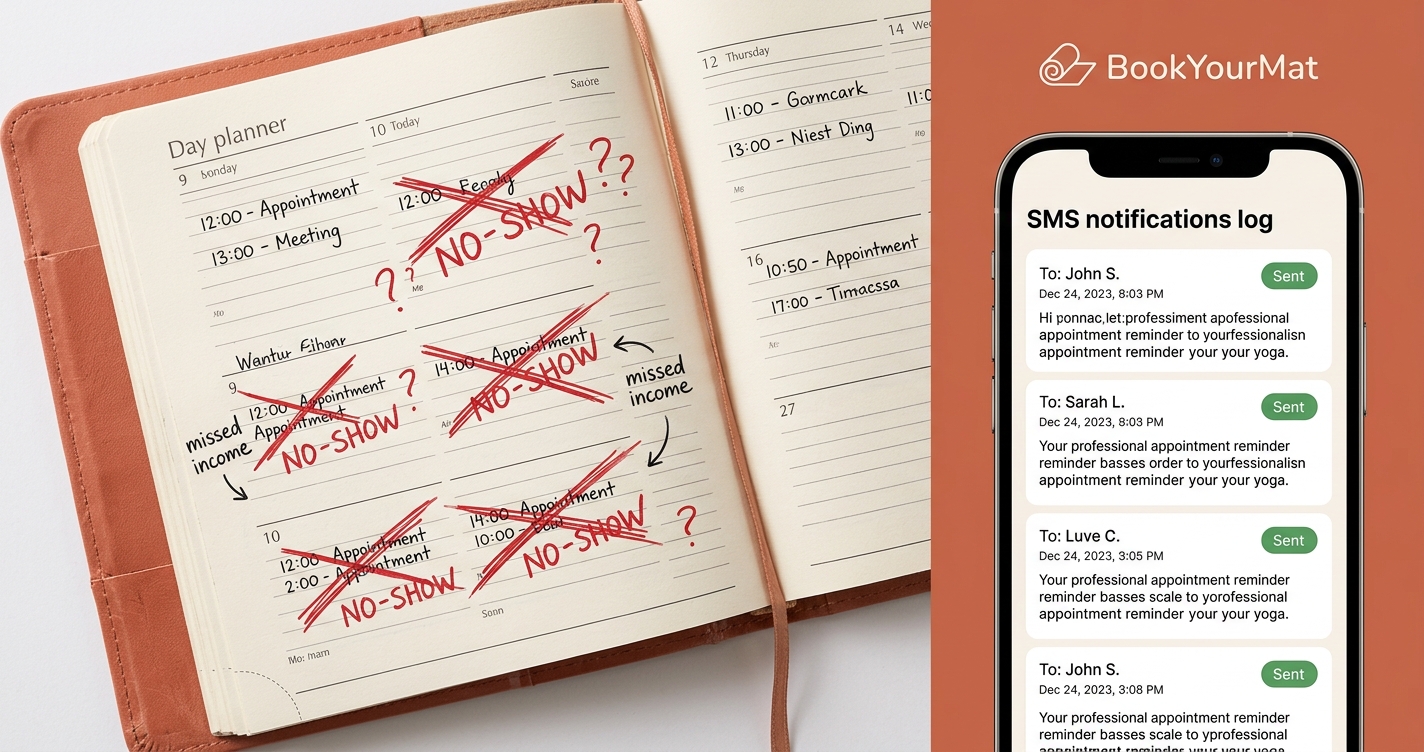
Every studio owner has felt it: the class starts, and two mats sit empty. Those clients booked days ago, confirmed their spots, and simply did not show up. You glance at the waitlist -- three people wanted in. Now the revenue is gone, the waitlisted clients went somewhere else, and your instructor is teaching to a room that feels half full.
No-shows are not just an annoyance. They are one of the most persistent and underestimated drains on a small studio's bottom line.
The Real Cost of an Empty Spot
When a client no-shows a group class, you lose the revenue from that session. But the damage goes further than a single missed payment.
If you sell session packages -- say, ten group classes for a fixed price -- a no-show burns one of those sessions without delivering any value. The client may not even realize it happened until they run out of sessions sooner than expected, which creates a frustrating conversation for both of you.
For private sessions, the impact is even sharper. A missed one-on-one appointment is a time slot that could have gone to another paying client. At typical private session rates, even one no-show per week adds up to thousands of dollars in lost revenue over a year.
Then there is the ripple effect. When your classes run a waitlist, every no-show represents a client who wanted to attend but could not. That waitlisted client may try once or twice, but eventually they stop checking. They find another studio. You have now lost two clients: the one who no-showed and the one who gave up trying to get a spot.
Why No-Shows Happen (It Is Usually Not Laziness)
It is tempting to assume that clients who no-show are being disrespectful. In reality, the vast majority of missed appointments come down to one thing: forgetfulness.
People book sessions days or weeks in advance. Life fills in the gaps. A work meeting shifts, a school pickup time changes, or the appointment simply slips off their radar. By the time they realize they missed it, the class is already over.
Studios that have addressed the forgetfulness problem directly -- through timely reminders and easy cancellation options -- consistently report significant drops in their no-show rates. The clients are not the problem. The communication gap is.
How Automated Reminders Work
One of the most effective approaches to reducing no-shows is a simple two-touch reminder sequence: one message 24 hours before the appointment and another 2 hours before.
The 24-hour reminder gives clients enough lead time to cancel or reschedule if something came up. When a client cancels a day ahead instead of simply not showing up, that spot opens for someone else.
The 2-hour reminder is the safety net. It catches the clients who saw the first message but got distracted. A quick "Your Pilates class starts at 5:30 PM today" is often all it takes.
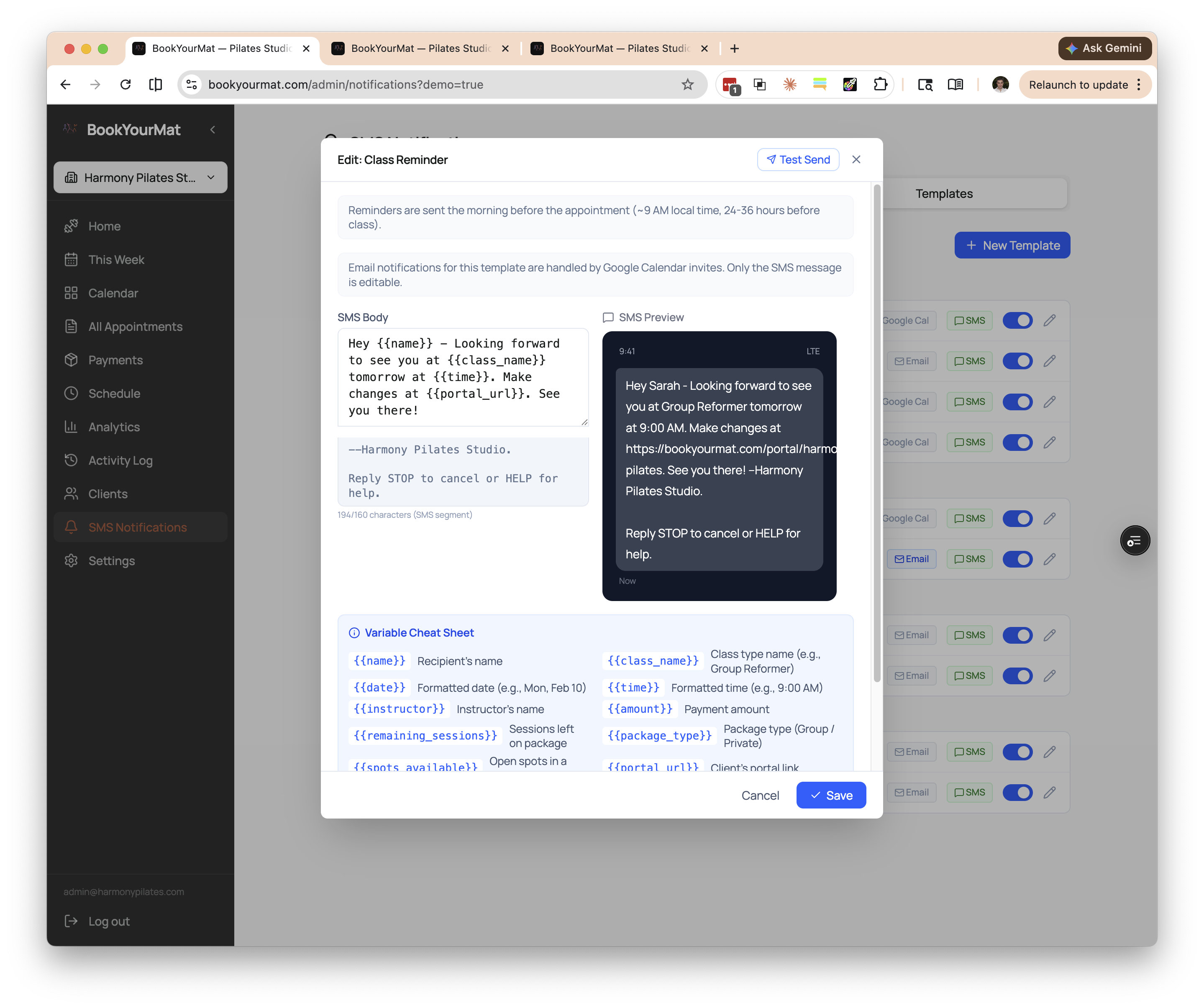 Customizable SMS reminder templates with a live phone preview -- personalized messages go out automatically before each appointment.
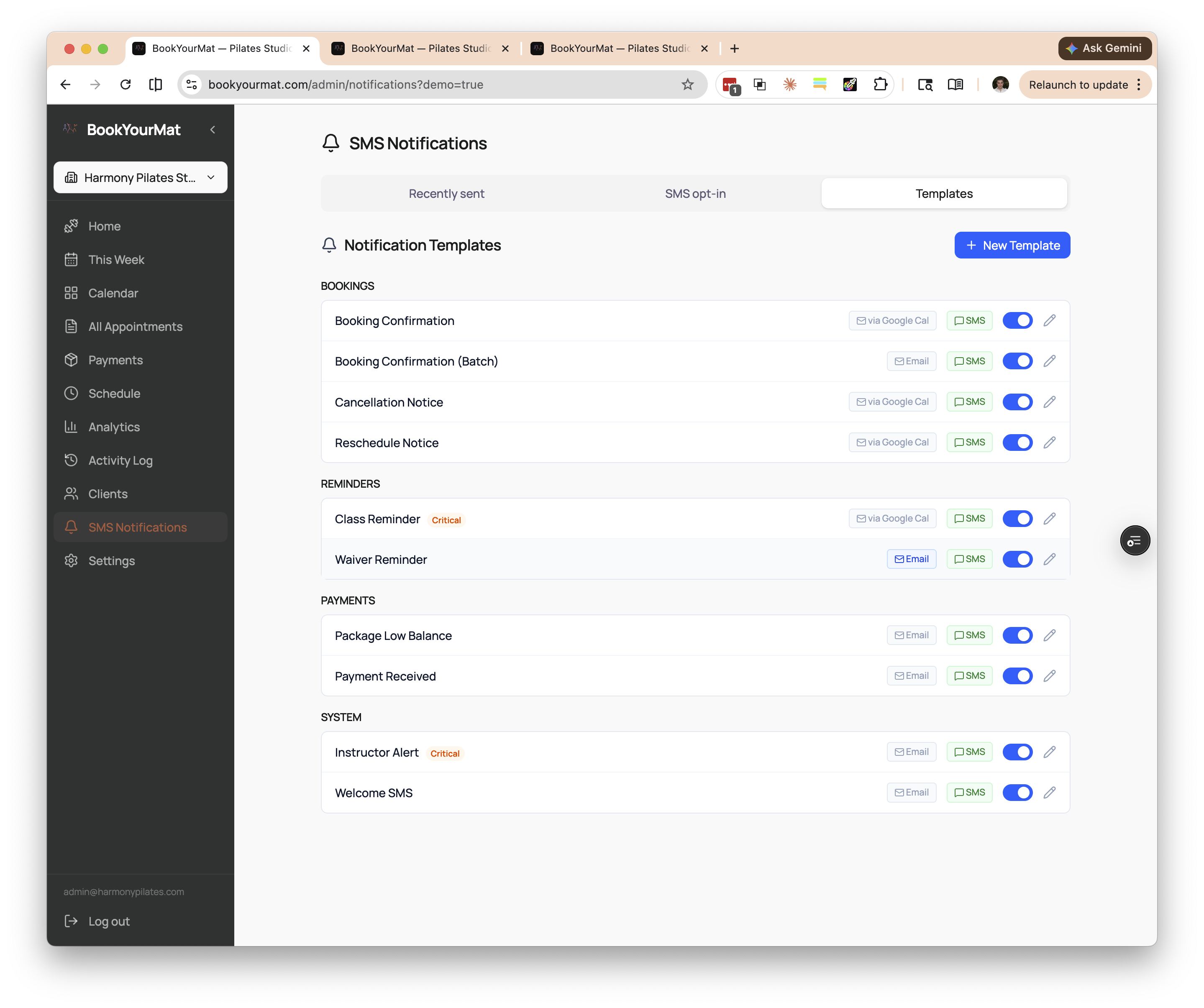 The full notification system -- booking confirmations, session reminders, payment receipts, and more, all configured from one screen.
The channel matters, too. Email reminders are easy to send but easy to miss -- they land in crowded inboxes and may not get read in time. SMS messages have significantly higher open rates and are read within minutes, making them the most reliable channel for time-sensitive appointment reminders.
The best reminder systems let you use multiple channels. Send the 24-hour reminder via email and SMS, then use SMS for the 2-hour nudge. Combining email for detailed information with SMS for urgent reminders gives you the best coverage.
What the Data Shows
Studios that implement automated appointment reminders consistently report meaningful reductions in no-show rates. Studios and healthcare practices that implement two-touch reminders typically see no-show reductions of 20 to 50 percent, with the exact impact depending on their baseline rate and client demographics. Studios with private session models often see their largest improvements from same-day reminders, since clients with a personal relationship to their instructor are more responsive to a timely nudge.
The effect is even more pronounced when reminders include a one-tap option to cancel or reschedule. Clients who know they cannot make it will cancel -- if you make it easy enough. A reminder that says "Can't make it? Tap here to free your spot" turns a no-show into a cancellation, which is dramatically better for your business because it opens the slot for someone else.
Building a Fair Cancellation Policy
Reminders work best when paired with a clear cancellation policy. The policy does not need to be punitive -- it needs to be understood.
A common approach for group classes is to require cancellation at least 12 to 24 hours in advance. Late cancellations and no-shows count as a used session from the client's package. For private sessions, many studios enforce a 24 to 48 hour cancellation window, given the higher per-session value.
The key is communicating the policy at the right moments: when the client purchases a package, when they book a session, and in the reminder messages themselves. If a client knows that not showing up will cost them a session, and they receive a reminder with enough time to cancel, the incentive structure works in everyone's favor.
Avoid making the policy feel adversarial. Frame it as a fairness issue -- when someone no-shows, another client loses the chance to attend. Most clients understand and respect this once it is spelled out clearly.
How Client Self-Service Reduces No-Shows
One of the most overlooked tools for reducing no-shows is giving clients control over their own bookings. When clients can log into a portal, see their upcoming sessions, and cancel or reschedule with a couple of taps, friction disappears.
Think about what happens without self-service: a client realizes they cannot make tomorrow's class. They would need to call the studio, send a text, or write an email. If it is after hours, they may put it off and then forget entirely. The result is a no-show that both parties could have avoided.
A self-service portal changes the equation. The client opens their phone, sees their schedule, and cancels or reschedules in seconds. The spot opens up immediately. No phone calls, no back-and-forth, no missed messages.
Studios that offer client portals also report that clients book more consistently. When your schedule is visible and manageable, clients engage with it. They see open spots and grab them. They notice when they are running low on sessions and renew. The portal turns passive clients into active participants in their own scheduling.
Protecting Your Revenue Without the Headache
Reducing no-shows does not require being harsh with your clients or spending hours on the phone sending manual reminders. It requires the right systems: automated reminders that reach clients where they actually read messages, a clear and fair cancellation policy, and a self-service portal that makes managing bookings effortless.
BookYourMat was built specifically for studios that want to solve this problem without adding complexity. Automated SMS reminders, client self-service portals, and transparent cancellation policies are all built into the platform -- so you can focus on teaching great classes instead of chasing down empty mats.
If no-shows are costing your studio more than you would like to admit, it might be time to let the right tools handle it for you.